
 EN
EN
 English
 Português



 C.V. Joints Explained: What Is a C.V. Joint and How Does It Drive Power to Wheels?


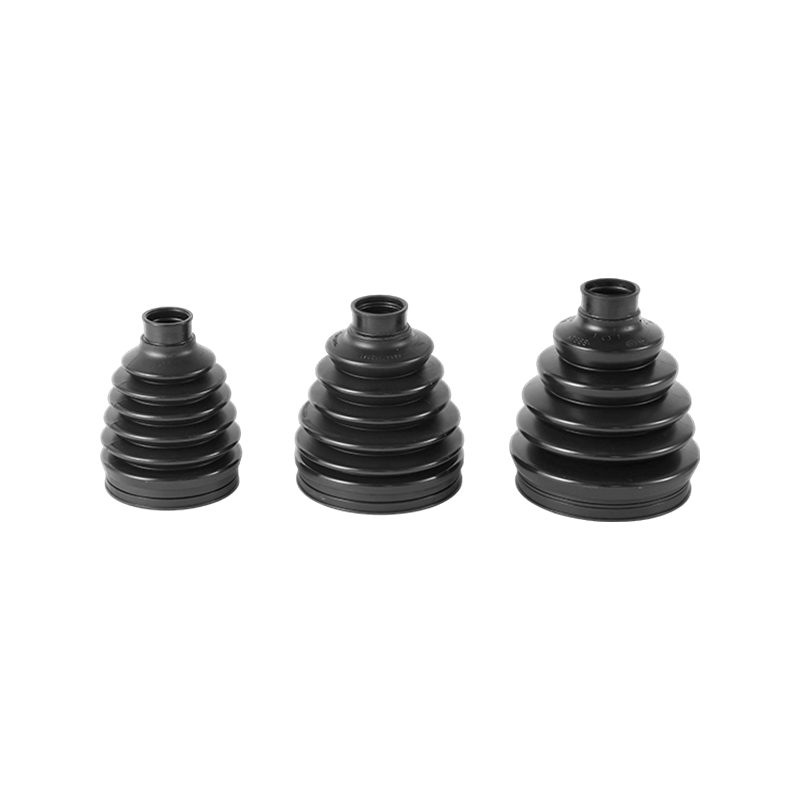
Yuhuan Bayzo Machinery Co., Ltd. is a China-based manufacturer of C.V. joints, drive shafts and drivetrain components, producing CV boot kit assemblies for the global automotive aftermarket. Our boot kits retain grease at the joint, seal out dust, mud and water, and protect the ball cage and raceways through the full range of suspension travel.
What Our CV Boot Kits Do in a Drivetrain
As a Universal CV Joint Boot Kits Manufacturers manufacturer, we match product configuration to the application, operating limits, interfaces and acceptance criteria defined for each project.
A constant velocity joint only survives when its grease charge stays in place and abrasives stay out. The boot is the barrier that makes this possible: it flexes with steering angle and suspension stroke while holding the lubricant against the cage, balls and raceways. Once a boot splits, grease is thrown clear and road grit enters the joint, and the resulting wear shows up as clicking on turns, vibration under load and eventual axle failure.
We build boot kits as complete replacement sets rather than loose rubber parts, so a workshop or distributor can restore a joint in one operation. Inner and outer boots use different designs and specifications and are not interchangeable, which is why our range is organised by joint position and by vehicle application.
Our Drivetrain Product Range
Boot kits sit inside a wider C.V. joint and drive shaft programme. The table below shows how each family fits an aftermarket or assembly requirement, so a project can be quoted as a single supply scope.
| Product family | Typical position | Application fit |
|---|---|---|
| CV boot kit | Inner and outer joint | Grease retention, dust and water exclusion, joint refurbishment |
| Inner C.V. Joints | Gearbox side | Plunge travel, torque transfer, inboard rebuilds |
| Outer C.V. Joints | Wheel side | Steering articulation, high-angle drive, wheel-end repair |
| Tripod Joints | Inboard, three-roller design | Plunge capacity on front-wheel-drive axles |
| Complete Drive Shaft Assemblies | Full axle | Drop-in replacement with joints and boots fitted |
| Drive Shaft Components | Shaft, cage, boot, hardware | Service parts and staged assembly programmes |
Two representative boot items in current production are the 103-2140/04438-16080/04427-0K020 Elastic Rubber CV Joint Dustproof Protective Boot and the 04427-0K020 Anti-leak Drive Shaft Ball Cage CV Bellows Cover. Both are supplied as boot-kit items with the sealing and fixing parts needed for installation.
Boot Construction and Material Selection
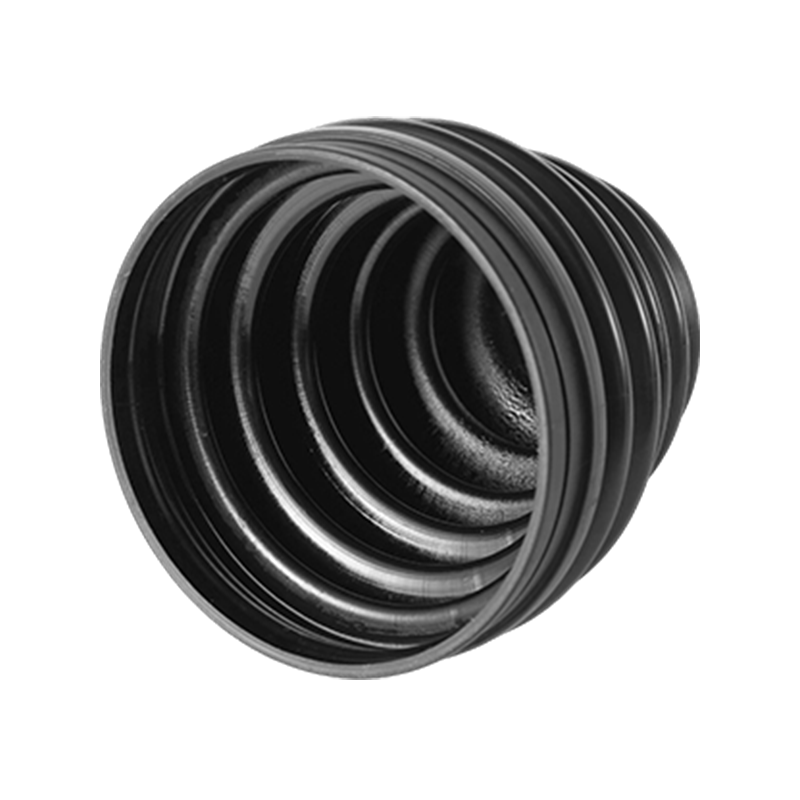
Boot life is decided by the compound, the wall thickness and the way the convolutions fold under articulation. We mould boots in elastic rubber for the general aftermarket, where resistance to ozone, grease attack and repeated flexing matters more than any single hardness figure. Neoprene and thermoplastic grades are used where a customer's market calls for higher temperature tolerance or improved low-temperature flexibility.
- Compound: elastic rubber, neoprene or thermoplastic elastomer matched to the grease type and operating temperature range.
- Geometry: convolution count and profile set by the joint's maximum articulation angle and plunge travel.
- Sealing faces: bore and shoulder dimensions controlled so the boot seats on the joint housing and shaft without pinching.
- Fixing: metal clamps sized to the shaft and housing diameters, with the correct band width for the boot neck.
- Grease charge: quantity specified per joint so the boot is neither starved nor over-filled during fitment.
Application Fit Across Vehicle Types
Boot kits are consumed in repair, not in new-vehicle assembly, so the range has to cover a wide spread of models with a manageable number of references. We group kits by joint position, shaft diameter, boot neck dimensions and the OE numbers they replace, which lets a distributor build a catalogue that covers high-turnover vehicles without carrying duplicates.
Passenger cars and light commercial vehicles dominate demand, particularly front-wheel-drive platforms where both inboard and outboard joints run in exposed positions. Higher-ride vehicles and heavier loads increase articulation and heat build-up, and those applications benefit from a boot with a stronger wall section and a compound that holds flexibility at low ambient temperature.
Specifications We Confirm Before Production
Every boot kit is defined by a small set of dimensions and material decisions. Confirming them at the sample stage prevents fitment returns later in the programme.
- Joint position: inboard or outboard, and joint type where the axle uses a tripod inboard design.
- Shaft diameter and housing bore at the boot seating faces.
- Boot length, convolution profile and maximum articulation angle.
- Compound grade and target operating temperature range.
- Clamp type, material and band dimensions.
- Grease type and charge weight per kit.
- Kit contents: boot, clamps, grease sachet, circlip or retaining parts as applicable.
Manufacturing and Quality Control
Bayzo operates in Yuhuan, Zhejiang, China's automotive parts manufacturing hub, with in-house production and inspection rather than outsourced trading. Our process runs from raw material control through moulding, CNC machining of metal components, assembly and final inspection, with each stage held to the same dimensional and appearance standard across batches.
For boot kits specifically, control points include compound batch verification, moulded wall thickness and convolution form, seating-face dimensions, clamp fit and kit completeness. Finished kits are checked before shipment for fitment accuracy, appearance consistency and correct contents, which is the practical basis for stable aftermarket supply.
OEM/ODM Development and Customisation
We develop boot kits from customer samples, drawings or OE numbers. A typical development sequence starts with the reference data, moves to a matched sample for fitment trial, and then to batch production once the sample is confirmed. Custom packaging, brand labelling and market-specific kit contents are available as part of the same programme.
Where a customer supplies a complete axle requirement rather than a boot alone, we can quote the boot kit alongside C.V. Joints and shaft assemblies so the joint, boot and hardware arrive as one matched set.
Installation, Maintenance and Serviceability
Correct installation determines whether a boot kit reaches its expected service life. The joint must be cleaned of old grease and debris, the new grease charge applied evenly around the cage and raceways, and the boot positioned without twisting before clamps are tightened. Air trapped inside the boot will push the convolutions outward under rotation, so the boot should be vented or equalised as the joint is reassembled.
- Inspect boots at every service interval for cracking, grease seepage or loose clamps.
- Replace the boot and grease together; reusing a boot after contamination shortens joint life.
- Check shaft and housing seating surfaces for scoring before fitting a new boot.
- Keep spare kits in the same reference grouping to simplify workshop stock.
Information We Use to Configure Your Solution
To prepare a boot kit configuration and quotation, we work from the following project inputs. Where a customer can supply OE numbers and a sample, matching is faster and more reliable.
- Vehicle make, model, year and axle position.
- OE number or competitor reference currently supplied.
- Sample boot or joint, or a dimensioned drawing.
- Joint type: ball-type inboard or outboard, or tripod inboard.
- Shaft diameter and housing bore at the sealing faces.
- Required compound and operating temperature range.
- Kit contents and packaging format, including branding requirements.
- Order quantity, delivery schedule and destination market.
Frequently Asked Questions
Can inner and outer CV boots be used interchangeably?
No. Inner and outer boots differ in bore, length, convolution profile and clamp sizing because the joints articulate and plunge differently. Fitting an outer boot to an inboard joint, or the reverse, will usually cause grease loss or boot damage within a short distance.
Do you supply boot kits as complete sets or as individual boots?
We supply complete kits containing the boot, clamps and grease, with retaining parts included where the application requires them. Individual boots can also be quoted where a customer's programme calls for them.
What material are your CV boots made from?
Our standard aftermarket boots are moulded in elastic rubber, with neoprene and thermoplastic grades available for applications needing higher temperature tolerance or better low-temperature flexibility. The compound is selected against the grease type and the operating conditions of the joint.
Can you develop a boot kit from an OE number only?
Yes. We develop from OE numbers, customer samples or drawings. An OE number lets us identify the joint family and likely dimensions; a sample or drawing then confirms the sealing faces and boot geometry before batch production.
Do you offer custom packaging and branding for boot kits?
We provide packaging solutions, brand labelling and related customisation based on customer requirements, including market-specific kit contents and printed packaging.
Which markets do you export CV boot kits to?
Our products are exported to Europe, America, the Middle East, Southeast Asia, Africa, Australia and other regions, alongside supply to the domestic market.